Packaging tool
DIM weight calculator
Dimensional weight (DIM weight) determines whether a carrier charges you based on the size of a box or the actual weight of the package. Use this calculator to estimate DIM weight and see whether your current box size is costing you more than it should.
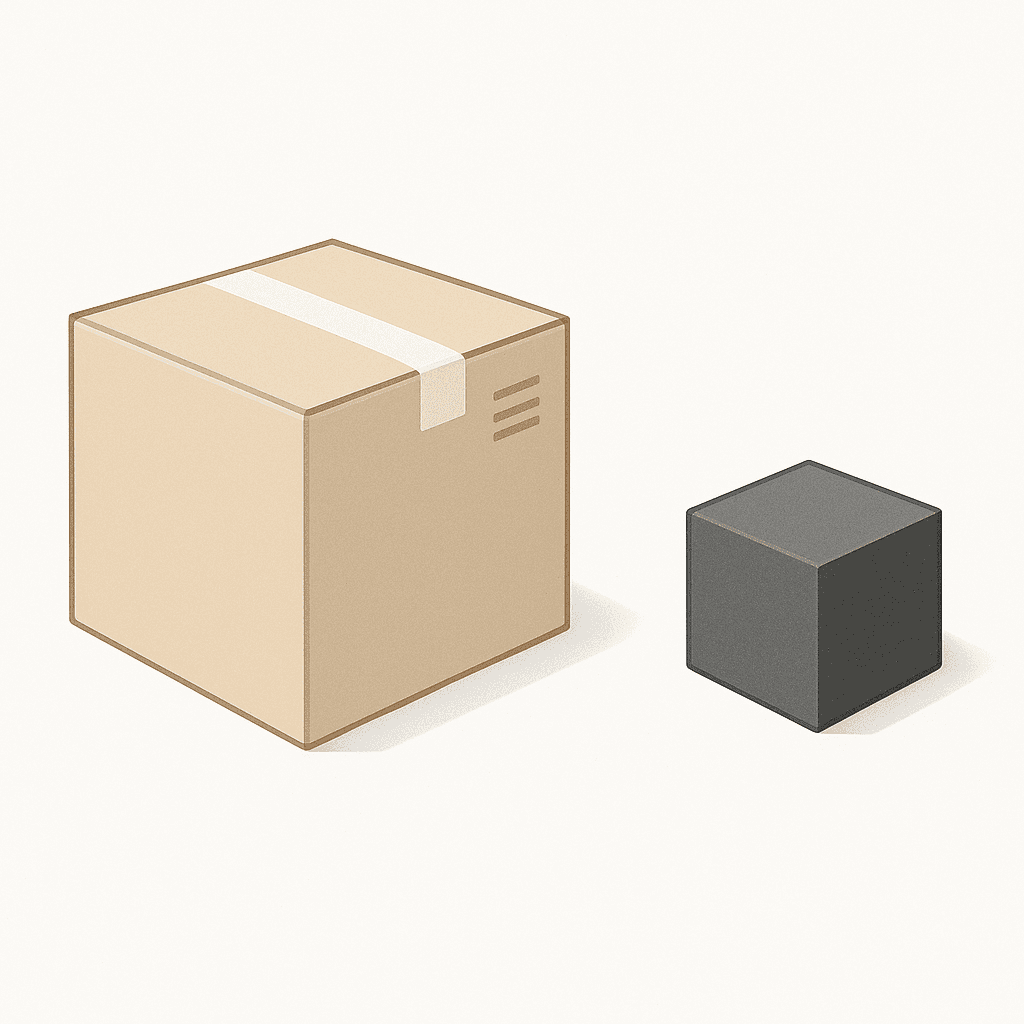
Enter box dimensions
All measurements in inches. Use outside dimensions for the most accurate DIM weight estimate.
Carrier / DIM divisor
Results
Carriers charge whichever is greater actual weight or DIM weight.
Cubic inches
—
L × W × D = ? × ? × ?
DIM weight
—
0 ÷ 139 = ? lbs
How dimensional weight works
Carriers like UPS, FedEx, and USPS use dimensional weight to price shipments that take up a lot of space but do not weigh much. The concept is simple: if a box is large relative to what is inside, the carrier charges you based on the space the box occupies in the truck or plane: not the actual weight on the scale.
The formula is straightforward. Multiply the box’s length, width, and depth (in inches) to get the cubic volume. Then divide by a carrier-specific divisor — typically 139 for UPS and FedEx domestic, or 166 for USPS. The result is the DIM weight in pounds. If the DIM weight exceeds the actual weight, the carrier bills the DIM weight.
This means an oversized box with empty space or void fill can cost significantly more to ship than a right-sized box with the same product inside. For e-commerce sellers and high-volume shippers, DIM weight optimization is one of the fastest ways to reduce shipping costs.
The formula
DIM Weight = (L × W × D) ÷ DIM Divisor
All measurements in inches. Round up to the nearest whole number. The carrier bills whichever is greater: actual weight or DIM weight.
How to reduce DIM weight charges
Right-size your boxes. The single biggest lever. Even reducing each dimension by 1–2 inches can drop your DIM weight into a lower billing tier. Stock 4–6 box sizes instead of using one oversized box for everything.
Use score-and-fold boxes. These have score lines at multiple heights, letting you fold the box down to fit the product. One box SKU covers multiple product heights.
Eliminate excess void fill. If you are adding air pillows or paper to fill empty space, the box is too big. Void fill is a symptom, not a solution.
Work with your corrugated supplier. A good supplier can recommend box sizes optimized for your product dimensions and carrier rate tiers. This is especially valuable for e-commerce operations shipping hundreds or thousands of packages per week.
Optimize your packaging
Find suppliers who can right-size your boxes
Browse the supplier directory to find corrugated box manufacturers and distributors who can help optimize your box dimensions for DIM weight savings.